IFMAKER M5: Fully Integrated Desktop 5-Axis CNC
135kg Cast-Iron Rigidity | 2.2kW Spindle | True 5-Axis Precision | Steel & Titanium Cutting | Beginner-Friendly CAM | Safety Assist
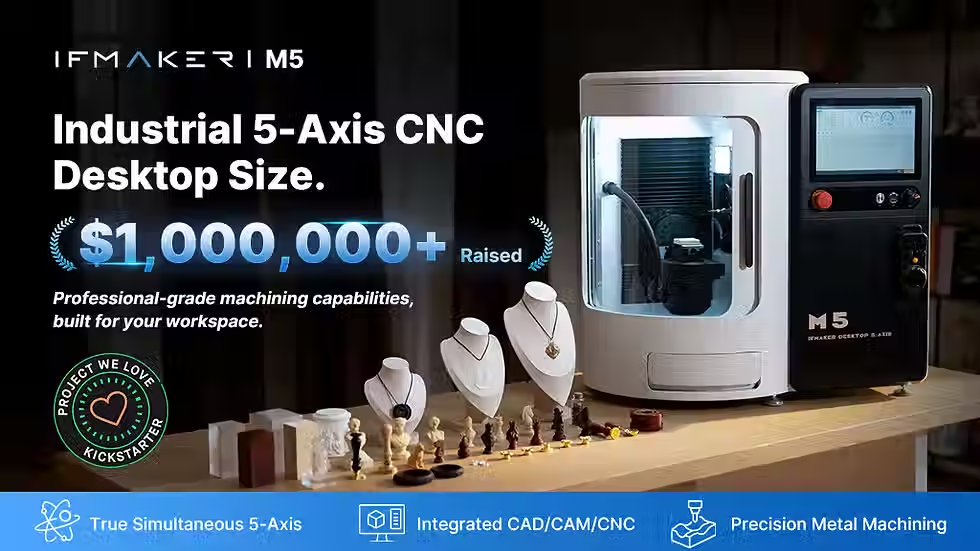
If you have ever wanted the capability to mill aerospace-grade aluminum or complex compound curves right at your desk without the massive price tag or footprint of an industrial machine, IFMAKER has engineered a serious solution. Launching on Kickstarter, the IFMAKER M5 is a fully integrated desktop 5-axis CNC mill. By combining a 135kg cast-iron base, a 60,000 RPM spindle, and simultaneous 5-axis motion with proprietary software, it brings factory-level precision into a small workshop or studio.
PROJECT OVERVIEW
Name and Creator IFMAKER M5: Fully Integrated Desktop 5-Axis CNC by IFMAKER.
What It Is The IFMAKER M5 is a compact, industrial-grade 5-axis CNC milling machine. Rather than using standard 3+2 positioning where the rotary axes lock in place, it features true simultaneous 5-axis movement (RTCP), allowing all axes to move at once to create complex geometries in a single setup.
KEY FEATURES
Simultaneous 5-Axis Machining The machine uses RTCP (Rotational Tool Center Point) architecture with ±0.06mm accuracy. This means all five axes move concurrently in real time, letting you machine complex curves, impellers, and undercuts without having to stop and reposition the workpiece.
Massive Iron Base To eliminate the vibrations that typically ruin desktop CNC cuts, the M5 is built on an integrated 135kg cast-iron chassis. This massive dampener ensures rock-solid accuracy while keeping operating noise surprisingly low.
High-Speed 2.2kW Spindle It is equipped with a closed-loop water-cooled spindle capable of reaching 60,000 RPM. This high-torque motor allows you to cut through tough materials like brass, aluminum, and titanium, delivering a mirror-like finish right off the machine.
Automatic Tool Changer (ATC) The system features a 4-slot automatic tool changer that handles complex toolpaths entirely on its own. After every swap, the machine triggers a micron-level calibration to lock in the exact tip position, ensuring seamless surface transitions.
In-House Integrated CAM Unlike most desktop mills that require expensive third-party CAM subscriptions, the M5 comes with IFMAKER's proprietary IF CAM software. It handles the entire pipeline locally, from importing the model to generating and simulating the toolpath.
AI and Wireless Integration The setup includes an AI assistant that can generate toolpaths from text prompts, alongside a NearLink wireless handwheel that offers near-zero latency and supports voice commands for setup and axis movement.
REWARDS
Kickstarter Pricing The campaign is highly successful, having raised well over $1 million. The entry point for the Super Early Bird Core Bundle starts at roughly $5,299.
Options The most popular tier is the Ultimate Bundle at $5,699, which represents a 30 percent discount off the planned $8,099 retail price. This bundle includes the metal end mill kit, collet pack, and material starter pack.
Delivery The campaign runs through mid-September 2026. IFMAKER has stated that production testing is complete and they are targeting global delivery beginning in December 2026.
CONCEPT
The core concept is Factory Precision on a Desktop. The creator, a veteran CNC systems engineer with 18 years of industrial experience, was frustrated that he could not find a capable 5-axis machine for his own DIY projects. By engineering a machine from the ground up, including writing the motion control algorithms and CAM software entirely in-house, the team aimed to democratize true 5-axis manufacturing, making it accessible to individual engineers and small studios.
INSPIRATION
The project was born from a fundamental belief that advanced manufacturing should not be locked behind corporate factory doors or crippling software licensing fees. The team noticed that most "desktop 5-axis" machines were actually just 3-axis mills with bolted-on rotary tables that lacked the rigidity for real metalwork. Recognizing this gap, they spent years developing a low-voltage servo system and proprietary software that work together seamlessly, eliminating the frustrating learning curve and calibration issues that typically plague consumer-grade CNC equipment.


